



Regulated Broker


 Author
Build Your Knowledge Before You Build Your Position
Forex trading is not only about understanding charts, indicators, or finding the perfect entry. Long-term development as a trader also requires an understanding of risk, psychology, market behaviour, discipline, probability, and decision-making. A good trading book may not tell you where EURUSD or Gold will move tomorrow. What it can do is help you understand how experienced traders think, manage uncertainty, control risk, and learn from mistakes.
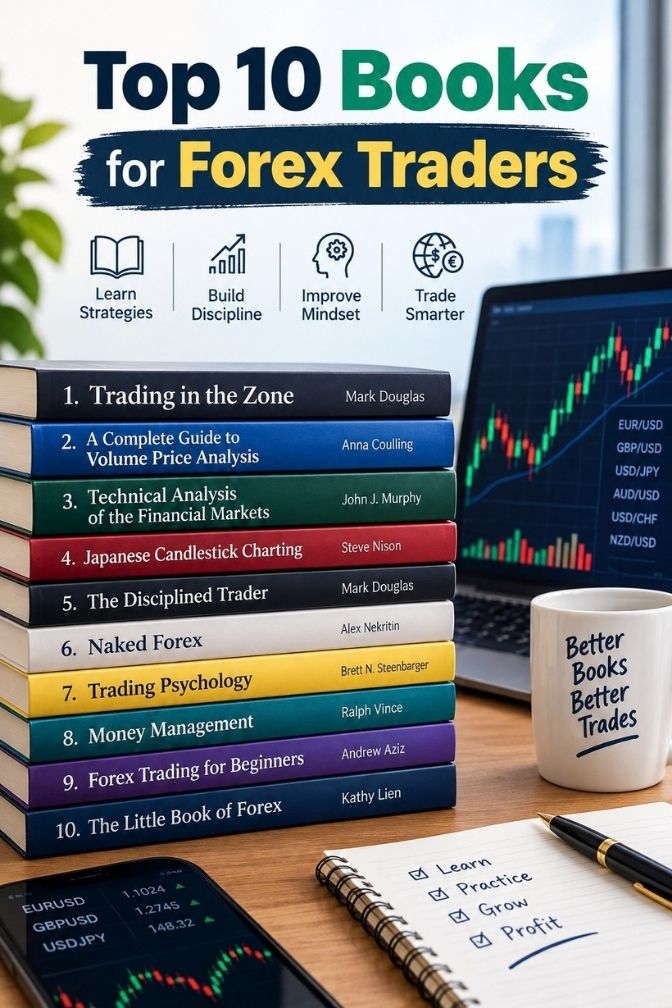
Here are 10 books that can help both beginner and experienced Forex traders develop a stronger foundation.
1. Trading in the Zone by Mark Douglas
What the Book Tries to Convey
Trading is a game of probabilities, not certainty. Mark Douglas explains why traders can have a good strategy and still struggle because of fear, hesitation, greed, or unrealistic expectations.
One of the central lessons is that the outcome of any individual trade is uncertain. A trader therefore needs to think across a series of trades rather than becoming emotionally attached to one position.
What a Forex Trader Can Learn
Develop discipline, accept losses as part of trading, avoid emotional decisions, and learn to execute a trading plan consistently.
2. Market Wizards by Jack D. Schwager
What the Book Tries to Convey
There is no single correct way to become a successful trader. The book contains interviews with highly successful traders who used very different methods. Some followed trends, some traded short-term, and others relied on fundamental analysis. Despite their different approaches, common themes repeatedly appear, particularly discipline, risk control, adaptability, and patience.
What a Forex Trader Can Learn
You do not necessarily need someone else's strategy. You need a trading approach that you understand, can test, and can execute consistently.
3. Reminiscences of a Stock Operator by Edwin Lefevre
What the Book Tries to Convey
Markets change, but human behaviour often does not. The book is inspired by the experiences of legendary speculator Jesse Livermore and explores speculation, market cycles, patience, losses, overconfidence, and crowd psychology. Although it was written long before modern Forex trading, many of its lessons remain relevant.
What a Forex Trader Can Learn
Patience can be more valuable than constant trading. Knowing when not to trade is an important skill.
4. The Disciplined Trader by Mark Douglas
What the Book Tries to Convey
The biggest obstacle to consistent trading can sometimes be the trader rather than the market. The book examines how beliefs, expectations, fear, and previous experiences influence trading decisions.
What a Forex Trader Can Learn
A strategy needs rules, but the trader also needs the discipline to follow those rules when real money and emotions are involved.
5. Technical Analysis of the Financial Markets by John J. Murphy
What the Book Tries to Convey
This is a broad introduction to technical analysis and how traders interpret price behaviour. It covers areas such as trends, chart patterns, support and resistance, moving averages, indicators, volume, and market relationships.
What a Forex Trader Can Learn
Rather than simply memorising indicators, traders can develop a better understanding of why price structure and market trends matter.
6. Japanese Candlestick Charting Techniques by Steve Nison
What the Book Tries to Convey
Candlesticks can provide information about the ongoing battle between buyers and sellers. The book helped popularise Japanese candlestick analysis in Western financial markets and explains patterns such as doji, engulfing patterns, hammers, and stars.
What a Forex Trader Can Learn
Candlesticks should not necessarily be treated as automatic buy or sell signals. They can be more useful when considered together with trend, support, resistance, and overall market context.
7. The New Trading for a Living by Alexander Elder
What the Book Tries to Convey
Trading requires a combination of method, psychology, and money management. A trader may understand technical analysis but still struggle if position sizing and emotional discipline are poor.
What a Forex Trader Can Learn
Entry strategy is only one part of trading. Risk management, record keeping, exits, and psychological discipline are equally important.
8. Fooled by Randomness by Nassim Nicholas Taleb
What the Book Tries to Convey
People frequently confuse luck with skill. A profitable trade does not automatically mean the decision was good, and a losing trade does not automatically mean the decision was bad. Randomness plays a significant role in financial markets.
What a Forex Trader Can Learn
Evaluate the quality of your trading process, not simply the result of one trade. This is particularly important when backtesting strategies or evaluating automated trading systems.
9. The Black Swan by Nassim Nicholas Taleb
What the Book Tries to Convey
Rare and unexpected events can have enormous consequences. Financial markets sometimes experience events that historical models, normal volatility assumptions, and conventional forecasts fail to anticipate.
What a Forex Trader Can Learn
Never assume that because something has not happened recently, it cannot happen. Position sizing, leverage management, diversification, and protection against extreme market conditions should be considered before the unexpected occurs.
10. Thinking, Fast and Slow by Daniel Kahneman
What the Book Tries to Convey
Human beings do not always make decisions as rationally as they believe. The book explores cognitive biases and two broad modes of thinking: fast, intuitive reactions and slower, more deliberate reasoning.
Although this is not specifically a Forex book, its lessons are highly relevant to trading.
What a Forex Trader Can Learn
FOMO, confirmation bias, overconfidence, loss aversion, and impulsive decisions can influence how traders interpret markets. A structured trading process can help reduce some of these behavioural mistakes.
What Do These 10 Books Have in Common?
Interestingly, these books do not point toward one perfect indicator or one guaranteed strategy. Their broader lessons repeatedly come back to a few principles.
Understand the Market
Learn price behaviour, trends, volatility, and market structure.
Understand Risk
Before thinking about potential profit, understand what happens if the trade goes wrong.
Understand Yourself
Fear, greed, overconfidence, impatience, and FOMO can damage even a reasonable trading strategy.
Think in Probabilities
One trade proves very little. A strategy needs to be evaluated across a meaningful sample of trades and different market conditions.
Keep Learning
Markets evolve. Technology changes. Volatility changes. A trader's approach must therefore continue developing as well.
Which Book Should a Beginner Read First?
A beginner does not need to read all 10 books immediately. A practical starting sequence could be: Start with Trading in the Zone to understand trading psychology.
Then read Technical Analysis of the Financial Markets to develop market knowledge.
Follow it with The New Trading for a Living to connect trading methods with risk and money management.
After gaining experience, books such as Market Wizards, Fooled by Randomness, and The Black Swan can help develop a deeper understanding of uncertainty and professional trading behaviour.
The purpose of reading trading books is not to copy another trader. It is to learn from decades of experience without having to personally make every possible mistake.
A trader who understands market behaviour, risk management, psychology, probability, and discipline has a stronger foundation for developing a trading approach that suits them.
Read. Learn. Test. Review. Improve.
Trading and leveraged products involve significant risk. Educational material should not be considered investment advice, and no trading method can guarantee future results.
 Read More