


Regulated Broker


 Author
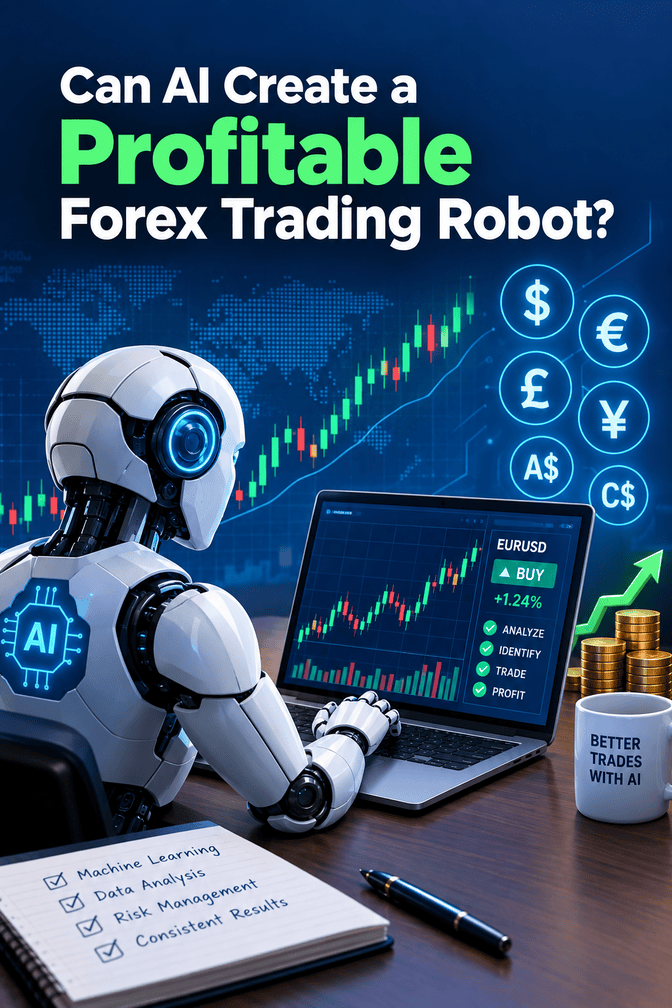
Artificial Intelligence (AI) is changing the way traders analyse the forex market and develop automated trading strategies. With the help of AI, traders can build forex trading robots that analyse market data, identify potential trading opportunities, and execute trades based on predefined rules.
But can AI really create a profitable forex trading robot? The answer depends on several factors, including the trading strategy, market conditions, risk management, and the quality of the data used to develop the robot.
What Is an AI Forex Trading Robot?
An AI forex trading robot is an automated trading system that uses artificial intelligence or machine learning techniques to analyse market data and support trading decisions.
Traditional trading robots usually follow fixed rules programmed by developers. AI-based systems can use historical and current market data to identify patterns and adjust their analysis, depending on how they are designed.
These systems can help traders reduce manual work and analyse market movements more efficiently.
How Can AI Create a Forex Trading Robot?
AI can support the development of a forex trading robot through several steps:
1. Market Data Analysis
AI can analyse historical price movements, trading indicators, and other market data to identify patterns that may help develop a trading strategy.
2. Strategy Development
Based on the selected approach, developers can use AI tools to help create trading rules, generate code, and develop automated strategies.
3. Trade Execution
Once connected to a supported trading platform, a properly configured robot can open, manage, and close trades according to its programmed rules.
4. Strategy Testing
Before using a robot with real money, traders can backtest its strategy using historical data and evaluate its performance under different market conditions.
Can an AI Trading Robot Make Consistent Profits?
AI can help develop trading systems, but it cannot guarantee consistent profits. The forex market is influenced by economic news, interest rates, geopolitical events, market sentiment, and unexpected price movements.
A strategy that performs well in historical testing may not perform the same way in live trading. Market conditions can change, and a robot may struggle when it encounters situations that were not represented in its training or testing data.
Profitability also depends on trading costs, spreads, slippage, leverage, and the effectiveness of the risk management system.
Therefore, traders should evaluate an AI trading robot based on its overall performance and risk, rather than focusing only on its potential profits.
AI Trading Robots vs. Traditional Expert Advisors
Traditional Expert Advisors (EAs) generally follow predefined trading rules. For example, an EA may open a trade when two moving averages cross.
An AI-based trading system may use machine learning to identify patterns in market data and generate signals based on its model. However, not every automated trading system uses AI, and an AI-assisted EA may still rely on fixed trading rules.
Both approaches require careful development, testing, and monitoring before being used in live markets.
Why Backtesting and Risk Management Matter
Backtesting helps traders understand how a trading strategy would have performed using historical market data. It can reveal potential weaknesses, drawdowns, and periods of poor performance.
However, backtesting alone is not enough. Traders should also consider:
Risk management: Set suitable position sizes, stop-loss levels, and maximum drawdown limits.
Out-of-sample testing: Evaluate the strategy using data that was not used during development.
Demo trading: Test the robot in simulated or demo-market conditions before risking real money.
Live performance monitoring: Regularly review results and check whether the strategy continues to perform as expected.
Trading costs: Include spreads, commissions, swaps, and possible slippage in performance calculations.
These steps can help traders understand a robot's limitations and avoid relying on unrealistic performance expectations.
Final Thoughts
AI can help traders develop forex trading robots, analyse market data, automate trading strategies, and improve the testing process. However, AI alone cannot guarantee a profitable trading system.
The key is to combine suitable strategy development, reliable testing, effective risk management, and continuous monitoring. Traders should understand how their robots work and recognise that losses are possible, even when a system has performed well in the past.
At Onexar, understanding trading technology and risk management can help traders make more informed decisions when exploring automated forex trading. Always evaluate an automated strategy carefully before using it in live markets.
Disclaimer: Forex and CFD trading involve a high level of risk and may not be suitable for all investors. Automated trading does not eliminate the risk of loss. Past performance does not guarantee future results.
 Read More