
Regulated Broker


 Author
If Most Forex Traders Lose Money, Is That a Problem or an Opportunity?
Discover a Different Approach to Trading with ONEXAR Reverse Copy Trading
Imagine this.
You are told that most retail traders lose money in the financial markets.
What would your first reaction be?
Would you see it as a problem?
Would you consider trading too risky?
Or would you look at the situation from a completely different perspective?
What if you could study the trading decisions of consistently losing traders and take the opposite side?
That's the idea behind Reverse Copy Trading.
At ONEXAR, we believe traders should have access to different ways of approaching the financial markets. Reverse copy trading offers an alternative to traditional copy trading by allowing traders to explore strategies based on taking opposite positions.
Let's understand how it works.
1. Most Traders Lose Money. But What If You Look at It Differently?
Retail Forex and CFD trading is challenging.
Broker risk disclosures frequently show that a majority of retail CFD accounts lose money, although the percentage varies by provider and reporting period.
Many traders struggle because of emotional decisions, poor risk management, excessive leverage, inconsistent strategies, and difficulty adapting to changing market conditions.
But consider this question:
If a trader repeatedly makes unsuccessful trading decisions, could taking the opposite side produce better results?
This is the basic idea behind reverse copy trading.
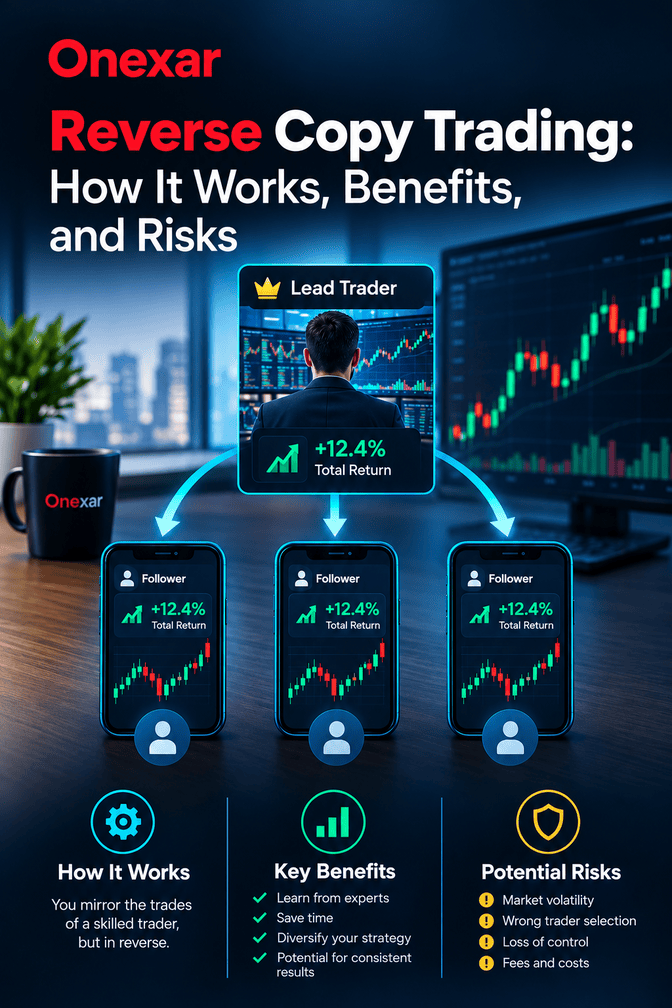
Instead of following a trader's positions in the same direction, a reverse copy trading system attempts to execute positions in the opposite direction.
However, there is an important distinction.
A trader who loses money is not automatically a profitable reverse trading signal.
The timing of entries, exits, spreads, commissions, and risk management all influence the outcome.
2. What Is Reverse Copy Trading?
Traditional copy trading allows one trading account to automatically follow the trades of another account.
For example:
If the master trader opens a BUY position on EURUSD, the follower account also opens a BUY position.
Reverse copy trading works differently.
When the source trader opens a BUY position, the reverse account opens a SELL position.
When the source trader opens a SELL position, the reverse account opens a BUY position.
Example:
Imagine a source trader buys Gold at $4,100.
Instead of copying the BUY position, the reverse trading account opens a SELL position, subject to its configured trading rules.
If Gold subsequently falls, the reverse position may generate a profit while the original BUY position experiences a loss.
But if Gold rises, the reverse account may lose money.
This means reverse copy trading is not a guaranteed profit system. It is a different trading approach that depends on the performance and behavior of the source strategy.
3. Why Can Reverse Copy Trading Be Interesting?
Many traders spend years searching for consistently profitable trading systems.
They test indicators, Expert Advisors, trading signals, and strategies.
But reverse copy trading introduces a different question:
Instead of searching only for successful traders, what if you analyzed traders whose strategies consistently perform poorly?
For example, a trader may repeatedly enter positions too late, close winning trades too early, or hold losing trades for too long.
A reverse trading system may attempt to benefit from certain recurring weaknesses in that trading behavior.
However, it is essential to distinguish between a genuinely unfavorable trading strategy and a trader experiencing temporary losses.
A strategy that loses during one market condition may become profitable during another.
Reverse copy trading therefore requires testing and monitoring rather than simply selecting the account with the largest losses.
4. The Challenges of Traditional Reverse Copy Trading
Setting up reverse copy trading independently can involve several technical and operational requirements.
Depending on the software and trading infrastructure used, traders may need:
A Virtual Private Server (VPS)
Many third-party trade copiers use a VPS to keep their software running continuously.
Copy Trading Software
Some trade copying solutions require monthly or annual subscription fees.
Multiple Account Connections
Connecting several source accounts can require additional configuration, software licenses, or subscription arrangements.
Technical Maintenance
Traders may need to monitor software connectivity, trading terminals, execution settings, and synchronization between accounts.
These requirements can make the process more complicated, especially for traders who do not have extensive technical experience.
5. ONEXAR Reverse Copy Trading – A Different Approach
ONEXAR aims to simplify access to reverse copy trading by reducing the need for separate third-party infrastructure.
No Separate VPS Charges for the Supported ONEXAR Solution
With ONEXAR's supported reverse copy trading arrangement, clients do not need to purchase their own VPS solely to operate the provided copying functionality.
This helps remove one of the common setup requirements associated with independently hosted trade copying systems.
Connect Multiple Source Traders
Instead of relying on only one source trader, ONEXAR's reverse copy trading arrangement is designed to allow one receiving account to connect with multiple source traders.
This provides greater flexibility when evaluating different trading behaviors and strategies.
Reverse Trading Functionality
The system can be configured to take the opposite direction of supported source trades.
Simplified Account Management
By reducing reliance on separate third-party software arrangements, the ONEXAR solution aims to make reverse copy trading easier to access and manage.
All functionality remains subject to account eligibility, supported configurations, execution conditions, and applicable service terms.
6. Can You Reverse Copy Multiple Losing Traders?
Imagine you have identified three traders whose historical strategies have produced consistent losses.
Trader A primarily trades Gold.
Trader B trades major currency pairs.
Trader C trades several Forex instruments.
Rather than depending entirely on one source trader, you may choose to connect multiple source accounts to your reverse trading arrangement.
For example:
Source Trader A
Opens a BUY position on Gold.
Your reverse account opens a SELL position.
Source Trader B
Opens a SELL position on EURUSD.
Your reverse account opens a BUY position.
Source Trader C
Opens a BUY position on GBPUSD.
Your reverse account opens a SELL position.
These are simplified illustrations. Actual trade copying depends on system settings, available margin, execution conditions, and the way source positions are managed.
Connecting multiple traders does not automatically reduce risk. Their positions may overlap or create correlated exposure.
The important objective is to evaluate whether the combined reverse strategy has a sustainable advantage after trading costs.
7. Does Reverse Copy Trading Guarantee Profits?
Absolutely not.
This is one of the most important things to understand.
Even if a source trader has consistently lost money, reversing their trades does not guarantee that your account will make money.
Why?
Because trading results depend on more than simply choosing BUY or SELL.
Consider a trader who buys Gold at $4,100 and closes the position at $4,095.
The original trader loses $5 per ounce.
A reverse trader who sells at exactly $4,100 and closes at exactly $4,095 would have a gross gain of $5 per ounce.
But in real trading, the reverse account may enter at a different price, experience slippage, pay spreads or commissions, or close at a different time.
These differences can reduce or eliminate the expected profit.
There is also the possibility that a previously losing trader begins performing well.
In that situation, the reverse strategy could start losing money.
Reverse copy trading requires the same discipline, testing, and risk management as any other trading strategy.
8. What Should You Check Before Selecting a Source Trader?
Choosing a source trader is one of the most important parts of the process.
Review the Trading History
Look beyond a few losing trades. Evaluate performance across different market conditions.
Understand the Trading Strategy
Determine whether the source trader uses scalping, trend trading, grid strategies, averaging, or other methods.
Examine Drawdowns and Position Sizes
A trader may show repeated small losses but occasionally generate very large profits. Reversing such a strategy could expose the receiving account to significant losses.
Evaluate Trading Costs
Check whether the expected reverse trading advantage remains after spreads, commissions, and execution differences.
Test Before Committing Significant Capital
Use historical analysis and, where available, demo or controlled forward testing before increasing trading exposure.
Monitor Performance Continuously
A source trader's behavior and results may change over time. Reverse strategies should be reviewed regularly.
9. Why Risk Management Is Still Essential
Reverse copy trading does not eliminate trading risk.
A receiving account may experience substantial losses when source traders change behavior, markets become volatile, or copied positions accumulate.
Traders should consider appropriate position sizing, maximum exposure limits, available margin, drawdown limits, and procedures for disconnecting underperforming sources.
Connecting multiple source traders can also create overlapping positions in Gold or correlated currency pairs.
The objective should not be to reverse as many trades as possible.
The objective should be to identify a repeatable trading advantage while controlling the risk involved.
10. Is Reverse Copy Trading Right for You?
Reverse copy trading may be worth exploring if you are interested in alternative trading approaches and understand the risks of leveraged Forex and CFD trading.
It may be particularly relevant to traders who want to study behavioral trading patterns, evaluate multiple source strategies, or test contrarian trading ideas.
However, it is not a substitute for trading knowledge, proper analysis, or risk management.
Historical losses in a source account are not proof that a reverse strategy will be profitable.
11. Explore Reverse Copy Trading with ONEXAR
Do you see consistently losing trading strategies as a problem?
Or do you see an opportunity to explore a different approach?
With ONEXAR Reverse Copy Trading, eligible traders can learn more about a solution designed to support opposite-direction copying, multiple source connections, and reduced dependence on separately purchased VPS infrastructure.
Interested in learning how ONEXAR Reverse Copy Trading works?
Contact our team for more information about account eligibility, available features, setup requirements, trading costs, and applicable conditions.
Email: support@onexar.com
WhatsApp: +971 50 733 2940
WeChat: Alex-4955
ONEXAR – Explore Trading from a Different Perspective.
Important Risk Disclosure
Forex and CFD trading involve significant risk and may not be suitable for all investors. Reverse copy trading is a speculative strategy and does not guarantee profits or eliminate market risk. Past losses of a source trader do not guarantee future profits for a reverse trading account.
Differences in execution prices, spreads, commissions, slippage, position sizing, and trading conditions may materially affect results. Multiple connected source accounts may increase exposure and create additional risks.
Clients should understand the strategy, applicable service conditions, and potential losses before participating.
 Read More